Online Newsroom Proposal

Online Newsroom Proposal

5 September 2021

Athelstone Football Club

An online newsroom will allow the Athelstone Football Club (AFC) to handle its own media strategy and create media suitable for journalists. The newsroom should be built into the AFC’s business plan, to increase community knowledge, improve accessibility, and facilitate traffic to its website with a focus on increasing memberships (Mahoney 2008, pp. 44-45).

The Athelstone Football Club’s (AFC) website is currently underutilised, and information is difficult to find or not available, therefore has difficulty communicating effectively to its stakeholders (Smith 2017, p. 221; Johnston 2018, p. 14).

A good example of a structured newsroom is the Australian Border Force website (Australian Border Force 2021). The newsroom is easily navigated and presents in a simple tabled format. The first column on the left contains searchable categories including archived content, contact and media details, subscription details, and social media links. The second or middle column displays news articles in chronological order that are regularly updated. Each article offers an option to download text, images, videos, and audio separately, and corresponding file sizes and resolution allows the journalist to acquire the correct format. At the bottom of the article, are contact details, and options to share, email or print to facilitate earned media. The third column on the right presents photos, videos, and audio. The media releases are searchable using tabs across the top of the page. The newsroom is detailed yet simple, and easy to navigate quickly (Smith 2017, pp. 221-224; Johnston & Rowney 2018, p. 14).

Contrastingly, the Adelaide Football Club’s newsroom is represented within a ‘latest’ tab and a drop-down list of ‘news’, ‘videos’, ‘photos’, and ‘Club Champion 2021’ (Adelaide Football Club 2021). The ‘news’ drop-down option displays a grid of tabulated media releases with large images that are chronologically ordered and regularly updated. Scrolling further down, the AFLW news is similarly displayed. Each article offers sharable options to Facebook and Twitter and a copy link tool. Large images and videos are presented within each media release as they are comprehended faster than text, however there is no ability to download. The media releases can be shared only and there are no contact details. Background information is found outside of the media tab, and located at the ‘Club’ tab, ‘Under Crows History Locker’. This is a link to another website, instead of being incorporated into the media page, as journalists would prefer. (Smith 2017, p. 221; Johnston & Rowney 2018, p. 17).

The AFC newsoom would benefit from a highly visual, searchable, and up-to-date newsroom in a table format. A communications or public relations officer should organise, create, and manage the information for the newsroom, and work on maintaining positive relationships with journalists (Mahoney 2008a, pp. 72, 85).

The newsroom would provide (Smith 2017, pp. 221-224):

  • information on current teams, players, committee members and coaches
  • statistics, history, and the club’s structure
  • images including size and quality
  • videos
  • fact sheets or background information
  • media releases or articles
  • media archives that can be used to correct inaccuracies
  • multi-media kits suitable for journalists
  • community interest topics and links
  • links to social media and other sporting clubs
  • contact details
  • an interview request form 
  • a calendar of events and activities
  • internal links.

Media releases should consider Journalists are time poor, and hence decisions on media releases’ newsworthiness are made usually within five seconds (Mahoney 2008a pp. 75, 85). Therefore, it’s important to write a media release in an inverted pyramid style within the email body without attachments to retain the journalist’s interest. Additionally, inserting a link to an embargoed password-protected media page within the newsroom (Smith 2017, p. 225) can provide the journalist with ‘multiple formats’ (text, video, images, infographics) to use across multi-media outlets (print, online and broadcast) (Mahoney 2008a, pp. 72-74; Weick 2015).

Media enquiries:

Julia Harold, Communications

m: 0000 444 333

e: abc@abc.com
Is Gender Bias Still At Play

Is Gender Bias Still At Play

Julia Harris
Sunday, 4 September 2021

Division 5 AFLW player Teearna Dios-Brun became interested in football “because every weekend I would go and watch my partner play.

I always thought that football was a sport for men because I never even saw anything different on TV,” Teearna explains.  Women have always been delegated to the sidelines. Females who resist, are called difficult and problematic as women are expected to know their place in society”.

Australian Rules Football, otherwise known as the AFL, football, or footy, is an Australian multibillion-dollar entertainment and sporting industry that’s closely guarded by men. They are the experts as its their sport and they’re the ones who created it, and who play it.

The AFL, the Seven Network and Foxtel, with the government facilitating the sport’s infrastructure, package the sport for our weekend entertainment. The commodification of football shapes our reality and guides our perceptions of Australian culture. It’s also a sport that no woman would ever be expected to participate in. This ideology has been ingrained into our culture for generations.

However, a persistent push by females against social norms, has ricocheted over the past twenty years, onto the Australian sporting landscape, and found itself changing the sacred AFL.

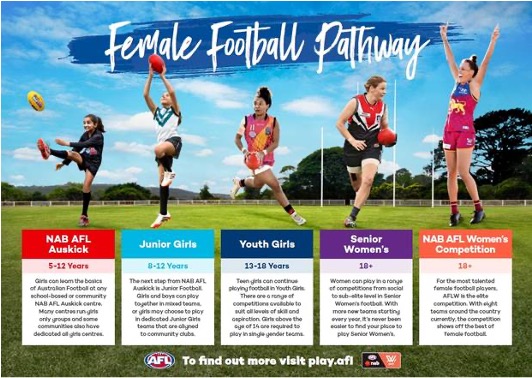
It began when the AFL first established Vickkick in 1985 within Victoria, and then Auskick nationally in 1995, to target children of both genders aged from five years to twelve. The program encouraged participation in football, to promote the AFL.

The female player age limit however, dictated by AFL’s The Female Participation Regulation, ruled that girls could not continue to play football after twelve years of age. This was challenged in 2003 by two Victorian girls, who argued the Regulation conflicted the Equal Opportunity Act (Victoria). Consequently, the AFL replaced the Regulation with the Gender Regulation Policy (Section 4) allowing girls aged up to age fourteen years to play. Though, yet again, girls aged over fourteen years were excluded from participation.

Fast forward to 2017 and the AFL established the AFL Women’s (AFLW), after an amplified growth in interest of females who wanted to play the sport. 

Pictured: Female Football Pathway
Source: aflcommunityclub.com

The AFLW is a tangible example of equal rights that females seek. In a momentous realisation, Teaarna excitedly says “I now strongly believe that women can play any sport that men can and do just as much as what men can do.” The visibility of female role models as both players and within commentary positions coincide with movements such as #MeToo that propel women’s rights and allow girls to dream big.

However, the game’s soul has been built on the back of tradition that originated 150 years ago, when the game was created as a space for men to release the hardships of the day, both as a spectator and player. It was a place where men could voice their emotions, among the gathering of like-minded communities. It was essentially, as a game for men.

In consideration, there is strong opposition and emotional reactions from men when changes to the game’s traditional rules occur, and when the game’s soul is seen to be under threat. In 2019, an image captioned, “Photo of the Year” of Carlton AFLW player Tayla Harris, was posted on the 7AFL Twitter account. The striking image attracted derogatory and sexualised comments and in response was hastily deleted. After enormous backlash, the image was re-posted with an apology and was replicated as a statue at Federation Square in Victoria, to symbolically represent women’s rights to play in the game. However, substantial opposition from high profile ex-players and coaches, for example, ex Crows Coach Malcolm Blight, questioned the statue’s suitability and worthiness, highlighting that many other male legends are bullied online and not represented.

Pictured: AFLW player Tayla Harris. Photograph: Michael Willson/AFL Media/Getty Images
(Source: TheGuardian.com)

Attaining equality in the AFL cannot be based solely on a female’s right to play. Even though females have reached permanent residency within the AFL, they are paid considerably less than men. Therefore, they work alongside their football obligations with less time to hone their skills.

An additional issue is the female skill level is not equal across all players. Many female players cross over from other sports, or from highly coached sporting backgrounds. With a superior level of skill, they can separate themselves from their team-mates, and become publicly recognised. For example, Crows AFLW player Erin Phillips, is a former Olympian and basketballer, and Tayla Harris, a former boxer. Inferior skills can be directly attributed to the limited infrastructure and high-level training while girls were growing up. The AFLW, therefore, will not reach its full potential until younger female generations with appropriate gender-based training facilities, amenities, and support, move through the system from an early age.

Importantly though, the photo and statue of Taylor Harris will forever be immortalised as a metaphor for equal rights and for females to be seen for what they do, rather than what they look like, or what they should be.

Media enquiries:

Julia Harold, Communications

Max Amber Sportsfield Hub

m; 0000 444 333.

e: abc@abc.com

Athelstone Football Club

MEDIA RELEASE

22 August 2021

Sporting code changes lead to multimillion dollar sporting hub redevelopment

The Max Amber Sportsfield is undergoing a $10 million sporting hub redevelopment designed for inclusivity and sustainability, as part of Federal, State and local government funding programs.

At over seven hectares and located at George Street, Paradise, the site’s potential was identified previously for redevelopment by the City of Campbelltown. The timing of the Sportsfield’s transformation into a sporting hub is in response to current sporting trends and the need to expedite sporting code changes at local community clubs.

The existing Max Amber Sportsfield’s clubrooms and amenities, built in 1976, were designed exclusively for male athletes. The new hub will reinvigorate a growing community and represent all members.

The President of the Athelstone Football Club Stephen Young said the Club is expected to thrive under the new design since the new infrastructure will be suited to all users, particularly females.

“There will be a sense of equality between the male and female sporting teams playing for the same code for the first time,” Mr Young said.

“The new amenities will empower our female users and the new changerooms will be suited to their needs – no longer will we see girls changing their clothes in cars or going home without showering.

“Just as exciting, lighting surrounding our clubrooms and amenities will be designed with safety in mind, and connect safely, the facilities to the expanded carparks.

“Without a doubt, the inclusion of female teams in football and cricket, has fast-tracked our redevelopment campaign, once the State and Federal Governments realised current sporting trends were here to stay.”

The new sporting hub, expected to be completed by 31 December 2021, will include male and female change rooms, a new two-storey club room, a re-aligned football field, separate tennis and soccer club rooms, a maintenance shed, cricket field, netball facilities, expanded carparking area, and with indigenous components incorporated into the design.

It will be home to the Athelstone Football Club, Athelstone Cricket Club, Athelstone Soccer Club, Athelstone Tennis Club, and used by the Eastern United Football Club, Norwood Soccer Club and the Australian Retired Persons Association.

The new sporting hub is funded by the Federal Government’s Community Development Grants program, the State Government’s Grass Roots Football, Cricket and Netball Facilities program, and the Australian Cricket Infrastructure Fund.

For more information, visit https://www.campbelltown.sa.gov.au/development/major-projects/max-amber-sportsfield-redevelopment or contact the City of Campbelltown on (08) 8366 9222.

Media enquiries:

Julia Harold, Communications, Max Amber Sportsfield Hub, 0000 444 333.

BACKGROUNDER

LONGEVITY

Athelstone Football Club was established in 1904 at the corner of Maryvale Road and Addison Avenue in Athelstone. Local gardeners used hessian bags as their guernseys, and became known as ‘The Raggies’, as they are still known today.

In 1971 the club moved to Foxfield Oval with separate clubrooms at Glynde, and by 1976, the club found its current home at 150 George Street, Paradise.

GAME HISTORY

The club has achieved varying successes over the years.

 In 1996 and again in 2019, the club won Division 2. During the season of 2020, the club played for Division 1. Today the club plays for the South Australian Amateur Football League (SAAFL).

The club is affiliated with the SAAFL and the North Eastern Metro Junior Football Association.

FEMALE PARTICIPATION

Female juniors started in 2018 and since 2019 a Women’s Team has participated in Division 5 (SAAFL).

UNSUITABLE INFRASTRUCTURE

Football games were experienced from the sidelines at below the level of the oval, which obscured views and detracted from the experience of the game. Infrastructure of the main clubrooms have been in decline for years.

FINANCES

The Athelstone Football Club struggled to increase memberships and lobbied the government for a redevelopment for many years. The old infrastructure failed to ignite interest from the community and find enthusiastic volunteers. The same volunteers were responsible for the club’s obligations placing a burden on their health and wellbeing. However, the club has been more successful in achieving sponsorships.

Inevitably, the club has traded at a loss, and regularly seeks financial assistance from the City of Campbelltown who have actively sought proposals for redevelopment since 2015.

STATISTICS

A total 7,594 women players were registered in SANFL football in 2019, and 10,000 participated within schools.

Of the total 2019 SA registered 54,290 players, females represented 14%.

Auskick female participation increased by 15% from 2018 to 2019.

By 2020, the increase rose by 24%.

Magarey Medallist Jade Sheedy has regularly coached the senior male team over the last 10 years in recognition of the senior committee member’s dedication and efforts.

MEDIA DISTRIBUTION LIST

1. Name: Brittany Evins

Email: evins.brittany@abc.net.au

Media: Australian Broadcasting Corporation (ABC)

Corporation Agenda Setting: framed to journalist views but within the interests of the community

Personal interest: Seeks original news stories, human interest, research.

News Value: Human Interest, Currency, Proximity.

Framing: The future success of the AFLW with the right infrastructure in place.

2. Name: Meriel Killeen

Email: killeen.meriel@hotmail.co.uk

Media: Glam Adelaide

Corporation Agenda Setting: A lifestyle focus promoting positive community events and outcomes.

Personal interest: A local community interest.

News Value: Human Interest, Currency, Proximity.

Framing: Positive and healthy lifestyle.

3. Name: Daniela Abbracciavento

Email: daniela.abbracciavento@news.com.au

Media: Messenger Community News

Corporation Agenda Setting: Local community orientation. Subsidiary of News Corp.

Personal interest: Interests cover AFL, Soccer, Tennis and Netball within the community.

News Value: Human Interest, Currency, Proximity.

Framing: Female organised sport successes.

4. Name: Tom Richardson

Email: tricharson@solsticemedia.com.au

Media: InDaily

Corporation Agenda Setting: Adelaide Independent News. Owned by Solstice Media.

Personal interest: Opinion writer

News Value: Negativity, Currency.

Framing: Inequality within organised sport.

5. Name: Andrew Capel

Email: andrew.capel@news.com.au

Media: The Advertiser, News Corp Australia

Corporation Agenda Setting: Aligned to the interests of Rupert Murdoch.

Personal interest: Thirty years’ experience. Keen interest reporting on the Adelaide and Port Adelaide football clubs. Grew up connected to a local community football club.

News Value: Currency, Human Interest, Currency

Framing: Families who grow up within organised sport.